
On this page
- What decides the size?
- How do they compare?
- Which houses usually need 6-inch?
- Which houses are fine with 5-inch?
- Is the problem size or something else?
- What about leaves?
- What is the bottom line?
- How do downspouts change the picture?
- What should you ask the contractor?
- Does size affect winter performance?
- What about townhouses?
- How much do the sizes differ in price?
- What does overflow tell you?
- Where should you go next?
What decides the size?
Three things about the roof:
- Area draining to the gutter. More roof means more water.
- Pitch. Steeper roofs shed water faster.
- Valleys. Concentrate water onto short stretches.
Then the weather. Reagan National's wettest month is July, about 4.3 inches, and summer thunderstorms are very frequent. Gutters need to handle short, intense bursts, not just the monthly total.
How do they compare?
| 5-inch K-style | 6-inch K-style | |
|---|---|---|
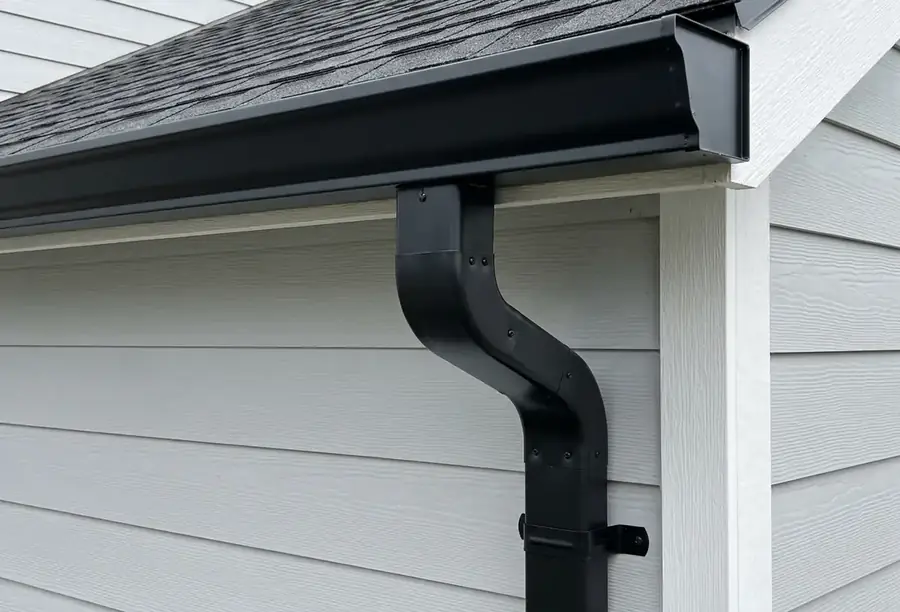
| Downspout | 2x3 inch | 3x4 inch |
| Capacity | Enough for many smaller roofs | Much more |
| Leaves | Smaller downspouts clog sooner | Larger downspouts pass debris |
| Look | In proportion on ramblers | In proportion on large homes |
| Price | Lower | A modest step up per foot (Pro Tool Reviews) |
Which houses usually need 6-inch?
- New infill homes. In neighborhoods like Pimmit Hills, where 833-square-foot originals are being replaced with far bigger houses.
- Large colonials and custom homes, common in places like McLean.
- Steep roofs and roofs with valleys.
- Any house where 5-inch gutters overflow when clean.
Which houses are fine with 5-inch?
- Postwar ramblers and Cape Cods with short, low-pitched runs, such as many homes in West Falls Church.
- Porches, garages and small additions.
- Townhouses with small roof sections, as long as there are enough downspouts.
Is the problem size or something else?
Before upsizing, check:
- Are the gutters clean? Most overflow around Falls Church is from clogged outlets.
- Are there enough downspouts? Adding one is cheaper than replacing every gutter.
- Is the slope right? A low spot can overflow even when clean.
- Is a valley the problem? A diverter or extra downspout near the valley may solve it.
What about leaves?
Under the heavy canopy of the City of Falls Church, the downspout size matters as much as the gutter. A 3x4 downspout clogs far less than a 2x3. Some contractors put 3x4 downspouts on 5-inch gutters under trees for that reason.
What is the bottom line?
Let the roof decide. Ask the contractor to explain the size they quote in terms of roof area and pitch, not just "that's what was there." See 6-inch gutters.
How do downspouts change the picture?
Size is not just about the trough. The downspouts set how fast the gutter empties, and under trees they are often the bottleneck:
| Setup | What it handles |
|---|---|
| 5-inch with 2x3 downspouts, few outlets | Small, low roofs with little debris |
| 5-inch with 3x4 downspouts | Small roofs under heavy trees |
| 5-inch with extra downspouts | Medium roofs where a bigger gutter would look heavy |
| 6-inch with 3x4 downspouts | Large, steep or tall roofs, valleys, heavy rain |
An extra downspout is often the cheapest fix for a gutter that overflows when clean.
What should you ask the contractor?
- How much roof area drains to each run?
- Did you allow for pitch and valleys?
- How many downspouts, and why there?
- Would 3x4 downspouts help with the trees over this roof?
- If you recommend 6-inch, which elevations need it and which do not?
A good answer explains the size with the roof, not with habit.
Does size affect winter performance?
Bigger gutters move snowmelt faster in a thaw, but the real winter risks are clogs and standing water that freeze. The area averages about 64 freezing nights a year. Whatever the size, gutters need a steady slope and clear outlets before the freezes start, which usually means cleaning after the leaves drop in late fall.
What about townhouses?
Townhouse roofs are smaller per unit, but tall facades mean water drops a long way when gutters overflow. Many townhouse communities set gutter color and style through the HOA. Adding a downspout is often allowed when changing size is not, so check the rules before choosing.
How much do the sizes differ in price?
National sources such as Pro Tool Reviews show 6-inch costing modestly more per foot than 5-inch, and 3x4 downspouts costing more than 2x3. On a typical house the difference is small next to the full job, which national guides put at roughly $9 to $13 a foot for seamless aluminum.
What does overflow tell you?
Watch the gutters in a heavy summer storm. Where the water goes over the edge points to the cause:
- Over the whole run, even when clean: the gutter is too small or has too few downspouts.
- At one inside corner: a valley is overloading that spot. A diverter or a downspout near the corner fixes it.
- Right beside the downspout: the outlet or downspout is clogged or too small.
- In the middle of a run: a low spot is holding water, or debris has piled up there.
Only the first case calls for a bigger gutter. The others are fixed with cleaning, re-hanging or an extra outlet, which costs far less than changing size along the whole house.
Where should you go next?
If the answer looks like a bigger gutter, read 6-inch gutters and the cost guide. If it looks like a clog or a low spot, read clogged gutters or sagging gutters. In either case, watching the gutters during one heavy storm, and taking a short video, gives a contractor most of what they need to advise you.