
On this page
- What is the difference?
- Why do joints fail around Falls Church?
- When does seamless pay off?
- When is sectional still fine?
- What makes a seamless job good?
- What does it cost?
- How do you tell which you have?
- Why did older houses get sectional gutters?
- What does a sectional leak cost over time?
- Are there any downsides to seamless?
- Which is better for a townhouse?
- What is the verdict?
- What questions should you ask about seamless?
- How do the two compare in winter?
- Where should you go next?
What is the difference?
| Sectional | Seamless | |
|---|---|---|
| How it is made | Pre-cut lengths joined on site | Formed on site to full length |
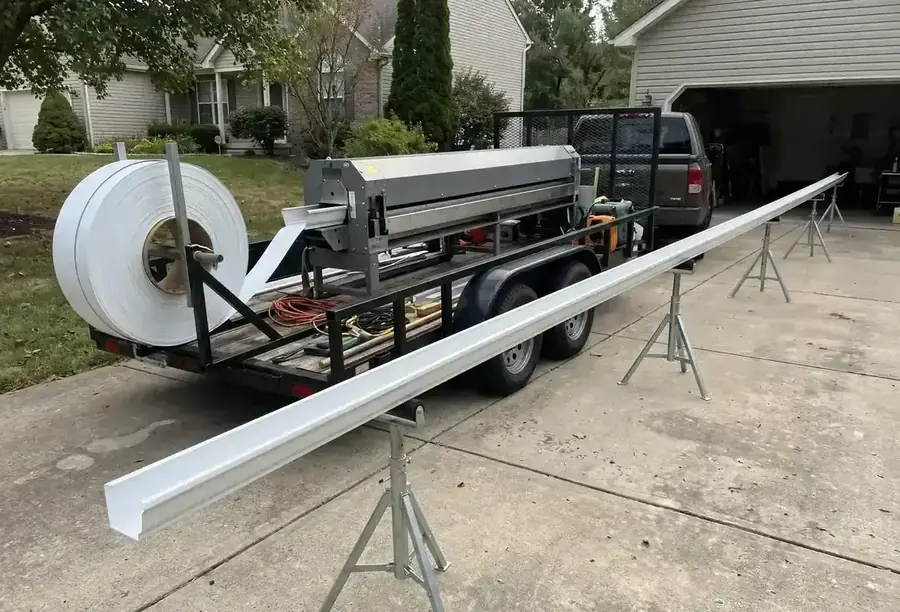
| Joints | Every 10 feet or so, plus corners | Corners, ends and outlets only |
| Leaks | At joints, as sealant ages | Far fewer leak points |
| Look | Visible seams | Clean, continuous line |
| DIY | Possible | Needs a contractor |
| Price | Material cheaper; labor similar | Installed price often similar |
Why do joints fail around Falls Church?
The area averages about 64 freezing nights a year, and many winter days freeze at night and thaw by afternoon. Each cycle works the sealant in a joint. Summer heat makes metal expand. Wet leaves sit on joints for weeks. Over years, the sealant cracks and the joint drips.
Many homes in the area date from the 1940s and 1950s to the 1970s, and their gutters have been through decades of this. Many older systems are sectional, and many now leak at several joints.
When does seamless pay off?
- On any full installation or replacement.
- When a sectional system leaks at many seams.
- On long runs, where sectional would need many joints.
When is sectional still fine?
- Short runs on sheds or small porches.
- Matching an existing sectional system for a small repair.
- DIY on a single-storey section.
What makes a seamless job good?
Seamless removes most joints, but the rest of the job still matters:
- Corners and end caps riveted and sealed properly.
- Hidden hangers about every two feet, into sound fascia.
- An even slope toward outlets, with no standing water.
- Drip edge so water enters the gutter.
- Enough downspouts. See downspouts.
What does it cost?
National guides put seamless aluminum at roughly $9 to $13 a foot installed. Compare that with the ongoing cost of resealing a leaking sectional system. See seamless gutters and the cost guide.
How do you tell which you have?
Walk the eaves and look under the gutter. Sectional gutters show a joint, usually with a connector strip and sealant, roughly every 10 feet. Seamless gutters run unbroken from corner to corner. If you see stains or drips at regular spacing along a run, that is almost certainly a sectional system leaking at its joints.
Why did older houses get sectional gutters?
Portable seamless forming machines became common later than many of the area's houses were built. Homes in West Falls Church, built mostly in the 1940s and early 1950s, and Pimmit Hills, built in the 1950s, would originally have had other systems. Many have since had partial replacements in sectional pieces bought by the length, which is why mixed systems are common.
What does a sectional leak cost over time?
| Year | What usually happens |
|---|---|
| Early years | Joints sealed and tight |
| Middle years | A few joints start to drip each spring after winter |
| Later years | Most joints have been resealed at least once; some leak again |
| End of life | Fascia damage below several joints; replacement needed |
Each round of resealing is a modest repair. National guides put typical repairs in the low hundreds of dollars. Several rounds, plus the wood damage leaks cause, can approach the cost of a seamless system.
Are there any downsides to seamless?
- You cannot install it yourself.
- Replacing a damaged section means forming a new full-length run.
- Very long runs may need an expansion joint.
- Corners and outlets still need careful sealing.
Which is better for a townhouse?
Seamless, in almost every case. Townhouse rows often have long continuous eaves where sectional joints add up quickly. HOA rules may set color and profile, but rarely require sectional.
What is the verdict?
For any new installation or replacement on a house, seamless is the better choice. Sectional still has a place for small DIY jobs and short repairs. See seamless gutters and leaking gutters.
What questions should you ask about seamless?
- Will every straight run be one piece?
- How are corners joined and sealed?
- What metal thickness is the coil?
- Do any runs need an expansion joint?
- What is the workmanship warranty on joints?
The answers separate a careful installer from a rushed one. Since most full installations cost more than $1,000, a Virginia contractor's license is required.
How do the two compare in winter?
In a winter with many freeze-thaw cycles, sectional joints are the weak points. Ice forms in any low spot, and joints that already have a hairline crack open further each time water freezes in them. Seamless runs have nothing to open along their length, so winter damage tends to show up only at corners or where hangers pull loose. With about 64 freezing nights a year on average, that difference adds up over a gutter's life.
Where should you go next?
Read seamless gutters for what installation involves, and leaking gutters if you are trying to keep a sectional system going a few more years. The cost guide helps compare the two paths over time.
If you are keeping a sectional system for now, reseal joints in early fall so they go into winter tight, and plan replacement when several joints need attention in the same year.