
On this page
- How do these guards work?
- Which trees do they handle?
- What are the drawbacks?
- What do they cost?
- Which should you choose?
- How are these guards installed?
- What maintenance do they need?
- How do they handle winter?
- When is a screen the right choice?
- When should you look elsewhere?
- How do screen guards compare on cost over time?
- What should you ask before buying?
- Where should you go next?
How do these guards work?
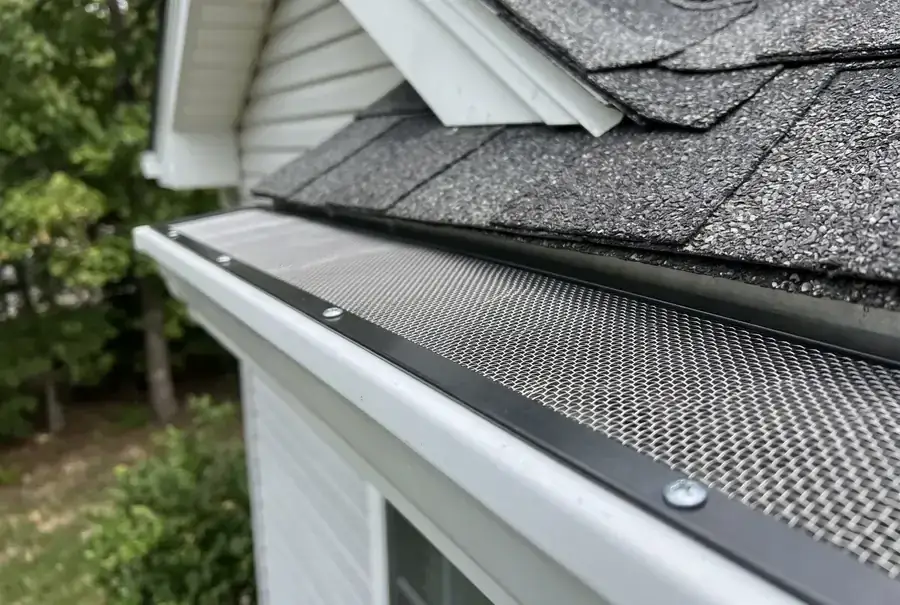
Perforated screens sit on top of the gutter. Water falls through the holes, and large leaves stay on top until wind or a brush clears them.
Reverse-curve guards cover the gutter with a solid hood. Water clings to the curved edge and flows into a narrow slot, while leaves slide off the front.
Which trees do they handle?
| Tree debris | Screen | Reverse-curve |
|---|---|---|
| Tulip-poplar and maple leaves | Good | Good |
| Oak leaves | Good | Good |
| Pine needles | Poor | Fair |
| Seeds, catkins, flower parts | Poor | Fair |
| Sweetgum balls and walnuts | Good | Good |
Around Falls Church, the mix of trees includes large-leaved species and many eastern white pines and dogwoods. Where needles and small seeds are a big part of what falls, micro-mesh does better.
What are the drawbacks?
- Screens let small debris through, so gutters still need occasional cleaning.
- Reverse-curve covers can overshoot in a summer downpour, and the slot can fill with fine debris that is hard to clear.
- Both are visible from the street. Reverse-curve hoods are especially noticeable.
- Cheap plastic versions warp, sag and blow out.
What do they cost?
National guides from Angi and HomeAdvisor show basic screens among the lowest-cost guards, with reverse-curve systems priced higher and often comparable to micro-mesh.
Which should you choose?
- Mostly big leaves, budget matters: a good metal screen.
- Pines, seeds or mixed trees: micro-mesh.
- No trees nearby: probably no guard at all; see are gutter guards worth it?.
How are these guards installed?
Screens usually snap onto the gutter lip and either slide under the shingles or rest on the roof edge. Some are fastened with screws to keep them from blowing out in wind. Reverse-curve systems replace the top of the gutter with a solid hood, often fastened to the roof deck under the shingles and to the front of the gutter.
Because reverse-curve covers change how water enters the gutter, they are usually sold as a full system and installed by the company that makes them.
What maintenance do they need?
| Guard | Maintenance |
|---|---|
| Perforated metal screen | Brush leaves off top; clear needles and seeds from holes; clean gutter below every year or two |
| Plastic screen | Same as metal, plus replacing warped or broken pieces |
| Reverse-curve | Clean the slot and the gutter below periodically; harder to access |
Under pines or seed-dropping trees, screens can need nearly as much attention as no guard at all.
How do they handle winter?
Snow and ice can sit on top of both kinds of guard, blocking the openings until it melts. Reverse-curve hoods can shed snow straight off the roof edge in a sheet. Neither type prevents ice dams, which start on the roof. The area averages about 13.7 inches of snow and 64 freezing nights a year. See ice dams and winter gutters.
When is a screen the right choice?
- The trees overhead drop mostly large leaves, not needles or small seeds.
- The budget does not stretch to micro-mesh.
- You do not mind brushing the screens occasionally.
When should you look elsewhere?
- Pines overhang the roof.
- Spring seed and flower drop is heavy.
- You want the least maintenance possible.
In those cases, micro-mesh usually works better over time.
How do screen guards compare on cost over time?
A cheap screen that needs brushing several times a year, plus a full cleaning every year or two, can end up costing more in time and service calls than a better guard. Under mostly large-leaved trees, a good metal screen is a fair middle ground. Under the mixed canopy common around Falls Church, where pines and seed-dropping trees are among the most common, micro-mesh usually costs more up front and less over the following years.
What should you ask before buying?
- Is the screen metal or plastic, and how thick?
- How does it attach, and will it blow out in wind?
- Does it go under the shingles, and does that affect my roof warranty?
- How will it handle needles and seeds from my trees?
- How do I clean it, and how often?
- What is the warranty, and what voids it?
Where should you go next?
Compare with micro-mesh guards, read are gutter guards worth it?, and see the gutter guards overview for prices and what any guard needs before it goes on. If your gutters already overflow when clean, fix that first; no guard can make an undersized gutter carry more water.
A sample panel held against your gutter shows quickly how a guard will look from the street.